|
The origins of Karate

OKINAWAN KARATE |
Karate is a martial art that originated in Okinawa and encompasses a variety of different styles, which are divided into several schools.
While studying at the two largest karate schools in the archipelago, Master Gichin FUNAKOSHI developed a completely new style, which he went on to spread throughout Japan: SHOTOKAN – literally “house under the trees.”
Shotokan karate aims not only to teach the art of combat, but also values such as loyalty, self-confidence, respect, and courtesy.
|
 Gichin FUNAKOSHI Gichin FUNAKOSHI |
|
Tsutomu OHSHIMA - SHOTOKAN Internationalization
“Use your mental attitude to look your opponent in the eye and understand their intentions.”

OHSHIMA Sensei |
Master OHSHIMA was born on August 6, 1930.
He began sumo training at the age of five.
Later, he took up kendo and judo.
As a student at Waseda University, he began karate training with Master FUNAKOSHI in 1948.
In 1955, he moved to the United States, where he founded Shotokan Karate of America the following year.
It is the oldest karate organization in the United States.
He recently appointed several shihan to succeed him as leaders of these associations.
The current Shihan for SUISSE SHOTOKAN is Patrick MOTTET (see below).
|
Bernard CHERIX
(July 6, 1927 – December 17, 2009)
1957
Student of Master OHSHIMA. Founded the first karate dojo in Switzerland, in Sion. |
1959
March 8: Member of the Swiss Commission of the Budo Association, karate responsible. |
1960
October 22: Member of the Technical Commission of the Swiss Judo Association, responsible for karate, which was later integrated. |
1963
September 22: Founder of the karate section of the Swiss Judo Association, section president. |
1966
November 19: The statutes of the Swiss Judo and Budo Federation are approved by the General Assembly in Lucerne. They come into force on January 1, 1967. Bernard Cherix takes over responsibility for the karate section. |
1970
January: The Swiss Judo and Budo Federation approves the founding of the Swiss Karate Federation. |
1970
August 29: First general meeting of the Swiss Karate Federation in Sion. Bernard Cherix participates as a founding member. |
1977
The Swiss Shotokan Karate Association was founded on May 7, 1977, in Bern. |
Patrick MOTTET
1982-2009
(Vice) President of the Black Belt Council |
1982-1997
Trainer and coach of the Swiss Shotokan Karate Team (SSK) |
2008-2011
Karate and Self-Defense" book & DVD (with B. Cherix) |
2009 / 2011
Honorary member of the SSK
Honorary chairman of the SSK |
2017
Appointed by Master OHSHIMA Shihan of Switzerland Shotokan, Germany Shotokan, Greece Shotokan, and Spain Shotokan |
|
|
Bernard CHERIX - Pioneer of SHOTOKAN in Switzerland
“The karateka must be aware of what this unconventional form of martial arts can offer him: very little if his goal is to dominate or impress others, but a great deal if he tries to be useful to his fellow human beings through self-control and dedication, by being friendly and respectful.”

Bernard CHERIX |
Bernard CHERIX was the pioneer of Karate in Switzerland.
After learning wrestling, judo, aikido, and jiu jitsu from various experts, he finally discovered karate in Paris.
Bernard CHERIX combined various techniques to develop a unique and particularly effective method of self-defense.
He documented its principles in his book “Karate and Self-Defense,” published in 2008.
Bernard CHERIX has been supporting the development of karate in Switzerland for many years.
Among other things, he was technical director, trainer, national trainer, and national coach of the karate section of the Swiss Judo and Budo Federation.
From 1965 to 1976, he was also vice president of the European Karate Union.
In 1966, he met Master OHSHIMA, an encounter that profoundly changed his approach to and understanding of karate.
Bernard CHERIX was a founding member of the European Karate Union, a founding member and honorary president of the Swiss Karate Federation, and a founding member and honorary president of SUISSE SHOTOKAN KARATE.
|
|
|
Patrick MOTTET - The "Guardian of tradition"
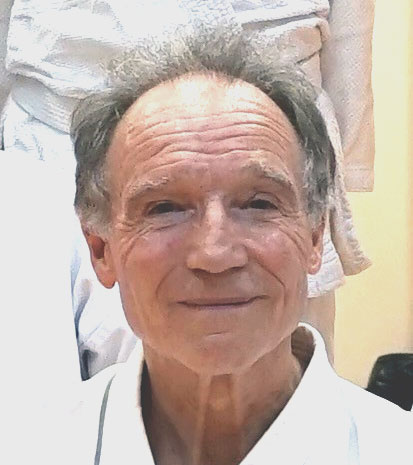
Patrick MOTTET |
Patrick MOTTET was born on October 27, 1957, in Saint-Maurice (VS).
At the age of eleven, in 1968, he began karate lessons under the guidance of Bernard CHERIX at the dojo in Sion, which was then still called the “Institut des sports de combat Sion.”
This encounter led to a friendship that lasted forty years, until Bernard Cherix's death.
Patrick passed his Shodan exam (1st DAN) in 1975, before obtaining the Nidan degree (2nd DAN) in 1977, in 1982, the Sandan degree (3rd DAN) in 1988, and the Yodan degree (4th DAN) in 1988. In August 2000, he received his Godan diploma (5th DAN) from Master OHSHIMA.
We would like to mention just a few of his many roles, responsibilities, and projects at SUISSE SHOTOKAN.
He was Vice President of the Black Belt Council (1982–2004), then President of the Black Belt Council from 2004 to 2009, trainer and coach of the SSK team (1982–1997) from 2002 to 2009, permanent partner of Bernard CHERIX for self-defense training, whose key elements he summarized in Bernard CHERIX's book entitled “Karaté et Self-défense” (2008), followed by a DVD in 2011. In 1993, he organized the international meeting of Shotokan associations in Leukerbad, which was preceded by a book he wrote on the history of Swiss Shotokan
He launched SSK's first website in 1996.
In 2007, he revised the SSK's statutes, and in 2012, he successfully developed and introduced the principle of special courses for members over 50.
On June 14, 2009, he was named an honorary member of Suisse Shotokan, and on June 4, 2011, he became honorary president of Suisse Shotokan.
In 2017, Master OHSHIMA named him Shihan of Switzerland Shotokan, Germany Shotokan, Greece Shotokan, and Spain Shotokan.
|
|


